AV node ablation for atrial fibrillation
How the heart's electrical system works
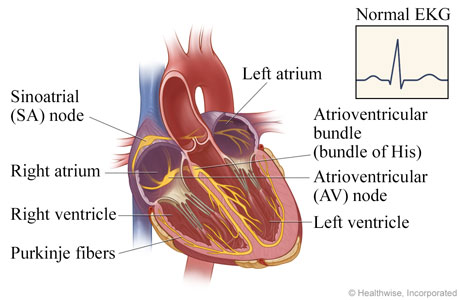
In a normal heart, electrical impulses pace the rhythm at which the heart contracts and relaxes. The sinoatrial (SA) node triggers the electrical impulse, causing the upper chambers (atria) to contract. The signal travels through the atrioventricular (AV) node to the atrioventricular bundle, which divides into the Purkinje fibers that carry the signal and cause the lower chambers (ventricles) to contract. The electrocardiogram (EKG, ECG) shows this normal electrical activity.
How atrial fibrillation happens
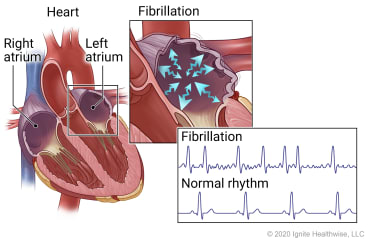
In atrial fibrillation, erratic electrical impulses in the upper chambers of the heart (atria) cause those chambers to fibrillate, or quiver. This results in an irregular and frequently rapid heart rate. The irregular, sawtooth pattern in the electrocardiogram (EKG, ECG) shows these erratic impulses.
Catheter is threaded through a vein to the heart
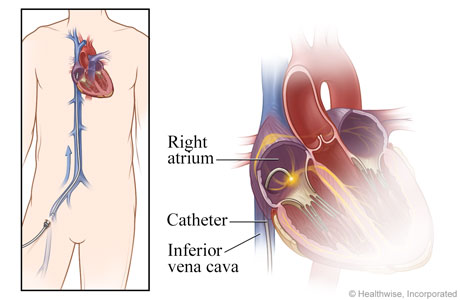
For this nonsurgical procedure, catheters are inserted into a vein, typically in the groin or neck, and threaded through the vena cava vein into the right atrium of the heart.
AV node is destroyed
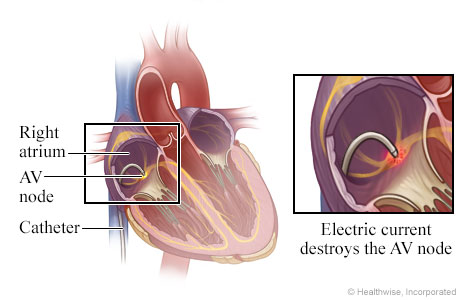
An electrode at the tip of the catheter sends out energy, such as radio waves, that destroys (ablates) the atrioventricular (AV) node or other heart tissue that is responsible for the erratic impulses.
Pacemaker controls the heart rhythm
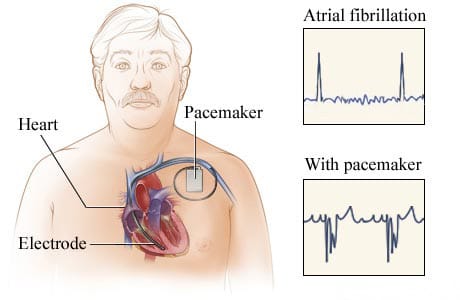
When the AV node is ablated, a permanent pacemaker is implanted that paces the ventricle. The pulse generator and battery part of the pacemaker are implanted under the skin of the chest. The electrocardiograms (EKG, ECG) show the heart's electrical activity during atrial fibrillation and when a heart has a pacemaker.
Current as of: October 2, 2025
Author:
All Ignite Healthwise, LLC education is reviewed by a team that includes physicians, nurses, advanced practitioners, registered dieticians, and other healthcare professionals.
This information does not replace the advice of a doctor. Ignite Healthwise, LLC, disclaims any warranty or liability for your use of this information. Your use of this information means that you agree to the
To learn more about Ignite Healthwise, LLC, visit
© 2024-2025 Ignite Healthwise, LLC.
Page Footer
I want to...
Audiences
Secure Member Sites
The Cigna Group Information
Disclaimer
Individual and family medical and dental insurance plans are insured by Cigna Health and Life Insurance Company (CHLIC), Cigna HealthCare of Arizona, Inc., Cigna HealthCare of Illinois, Inc., Cigna HealthCare of Georgia, Inc., Cigna HealthCare of North Carolina, Inc., Cigna HealthCare of South Carolina, Inc., and Cigna HealthCare of Texas, Inc. Group health insurance and health benefit plans are insured or administered by CHLIC, Connecticut General Life Insurance Company (CGLIC), or their affiliates (see
All insurance policies and group benefit plans contain exclusions and limitations. For availability, costs and complete details of coverage, contact a licensed agent or Cigna sales representative. This website is not intended for residents of New Mexico.