Childhood Nasopharyngeal Cancer (PDQ®): Treatment - Patient Information [NCI]
What is childhood nasopharyngeal cancer?
Childhood nasopharyngeal cancer is a rare type of cancer that forms in the tissue lining the nasopharynx. The nasopharynx is the upper part of the throat behind the nose. The nostrils allow air into the nasopharynx. Air and food pass through the pharynx on the way to the trachea or esophagus.
Nasopharyngeal cancer is more common in children aged 10 to 19 years than in children younger than 10 years.
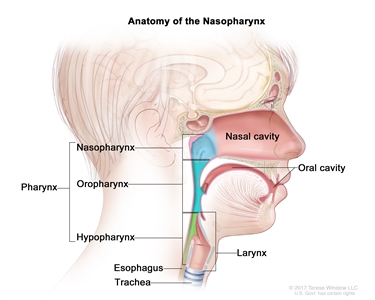
Anatomy of the nasopharynx. The nasopharynx is in the upper part of the pharynx (throat) behind the nose. The nostrils lead into the nasopharynx. An opening on each side of the nasopharynx leads into the ear.
Stages of childhood nasopharyngeal cancer
The cancer stage describes the extent of cancer in the body, such as the size of the tumor, whether it has spread, and how far it has spread from where it first formed. It is important to know the stage of nasopharyngeal cancer to plan the best treatment.
There are several staging systems for cancer. Nasopharyngeal cancer staging usually uses the TNM staging system. You may see your child's cancer described by this staging system in the pathology report. Based on the TNM results, a stage (I, II, III, or IV, also written as 1, 2, 3, or 4) is assigned to your child's cancer. When talking with you about your child's cancer, your child's doctor may describe it as one of these stages.
Learn more about
Learn about the
Stage 0 nasopharyngeal cancer
In stage 0, abnormal cells are found in the lining of the nasopharynx. These abnormal cells may become cancer and spread into nearby normal tissue. Stage 0 is also called carcinoma in situ.
Stage I nasopharyngeal cancer
In stage I, nasopharyngeal cancer has formed and is found in the nasopharynx only or has spread from the nasopharynx to the oropharynx and/or nasal cavity.
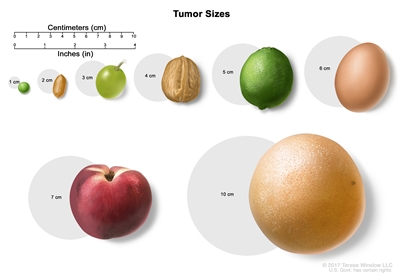
Tumor sizes are often measured in centimeters (cm) or inches. Common food items that can be used to show tumor size in cm include: a pea (1 cm), a peanut (2 cm), a grape (3 cm), a walnut (4 cm), a lime (5 cm or 2 inches), an egg (6 cm), a peach (7 cm), and a grapefruit (10 cm or 4 inches).
Stage II nasopharyngeal cancer
Stage II is based on the location of the cancer and whether it has spread. A child may have one of the following:
- Cancer has spread to one or more lymph nodes on one side of the neck and/or to one or more lymph nodes on one or both sides of the back of the throat. The affected lymph nodes are 6 centimeters or smaller. Cancer is found:
- in the nasopharynx only or has spread from the nasopharynx to the oropharynx and/or to the nasal cavity; or
- only in the lymph nodes in the neck. The cancer cells in the lymph nodes are infected with Epstein-Barr virus (a virus linked to nasopharyngeal cancer). Cancer was not found in the nasopharynx.
- Cancer has spread to the parapharyngeal space and/or nearby muscles. Cancer may have also spread to one or more lymph nodes on one side of the neck and/or to one or more lymph nodes on one or both sides of the back of the throat. The affected lymph nodes are 6 centimeters or smaller.
Stage III nasopharyngeal cancer
Stage III is based on the location of the cancer and whether it has spread. A child may have one of the following:
- Cancer has spread to one or more lymph nodes on both sides of the neck. The affected lymph nodes are 6 centimeters or smaller. Cancer is found:
- in the nasopharynx only or has spread from the nasopharynx to the oropharynx and/or to the nasal cavity; or
- only in the lymph nodes in the neck. The cancer cells in the lymph nodes are infected with Epstein-Barr virus (a virus linked to nasopharyngeal cancer). Cancer was not found in the nasopharynx.
- Cancer has spread to the parapharyngeal space and/or nearby muscles. Cancer has also spread to one or more lymph nodes on both sides of the neck. The affected lymph nodes are 6 centimeters or smaller.
- Cancer has spread to the bones at the bottom of the skull, the bones in the neck, jaw muscles, and/or the sinuses around the nose and eyes. Cancer may have also spread to one or more lymph nodes on one or both sides of the neck and/or the back of the throat. The affected lymph nodes are 6 centimeters or smaller.
Stage IV nasopharyngeal cancer
Stage IV is subdivided based on whether the cancer has spread to other tissue.
- In stage IVA:
- Cancer has spread to the brain, the cranial nerves, the hypopharynx, the salivary gland in front of the ear, the bone around the eye, and/or the soft tissues of the jaw. Cancer may have also spread to one or more lymph nodes on one or both sides of the neck and/or the back of the throat. The affected lymph nodes are 6 centimeters or smaller; or
- Cancer has spread to one or more lymph nodes on one or both sides of the neck. The affected lymph nodes are larger than 6 centimeters and/or are found in the lowest part of the neck.
- In stage IVB: Cancer has spread beyond the lymph nodes in the neck to distant lymph nodes, such as those between the lungs, below the collarbone, or in the armpit or groin, or to other parts of the body, such as the lung, bone, or liver.
Stage IV nasopharyngeal cancer is also called metastatic nasopharyngeal cancer. Metastatic cancer happens when cancer cells travel through the lymphatic system or blood and form tumors in other parts of the body. The metastatic tumor is the same type of cancer as the primary tumor. For example, if nasopharyngeal cancer spreads to the lung, the cancer cells in the lung are actually nasopharyngeal cancer cells. The disease is called metastatic nasopharyngeal cancer, not lung cancer. Learn more in
Recurrent nasopharyngeal cancer
Recurrent nasopharyngeal cancer is cancer that has come back after it has been treated. Nasopharyngeal cancer may come back in the nasopharynx, or in other parts of the body, such as the bone, lung, or liver. Tests will be done to help determine where the cancer has returned in the body, if it has spread, and how far. The type of treatment that your child will have for recurrent nasopharyngeal cancer will depend on where it has come back.
Learn more in
This information does not replace the advice of a doctor. Ignite Healthwise, LLC, disclaims any warranty or liability for your use of this information. Your use of this information means that you agree to the
Healthwise, Healthwise for every health decision, and the Healthwise logo are trademarks of Ignite Healthwise, LLC.
Page Footer
I want to...
Audiences
Secure Member Sites
The Cigna Group Information
Disclaimer
Individual and family medical and dental insurance plans are insured by Cigna Health and Life Insurance Company (CHLIC), Cigna HealthCare of Arizona, Inc., Cigna HealthCare of Illinois, Inc., Cigna HealthCare of Georgia, Inc., Cigna HealthCare of North Carolina, Inc., Cigna HealthCare of South Carolina, Inc., and Cigna HealthCare of Texas, Inc. Group health insurance and health benefit plans are insured or administered by CHLIC, Connecticut General Life Insurance Company (CGLIC), or their affiliates (see
All insurance policies and group benefit plans contain exclusions and limitations. For availability, costs and complete details of coverage, contact a licensed agent or Cigna sales representative. This website is not intended for residents of New Mexico.