Chronic Myeloid Leukemia Treatment (PDQ®): Treatment - Patient Information [NCI]
General Information About Chronic Myeloid Leukemia
Chronic myeloid leukemia is a disease in which the bone marrow makes too many white blood cells.
Chronic myeloid leukemia (also called CML or chronic myelogenous leukemia) is a slowly progressing blood and bone marrow disease that usually occurs during or after middle age and rarely occurs in children.
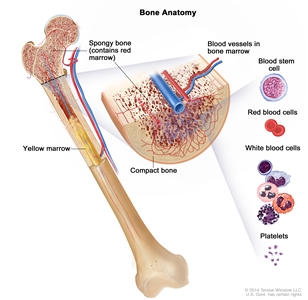
Anatomy of the bone. The bone is made up of compact bone, spongy bone, and bone marrow. Compact bone makes up the outer layer of the bone. Spongy bone is found mostly at the ends of bones and contains red marrow. Bone marrow is found in the center of most bones and has many blood vessels. There are two types of bone marrow: red and yellow. Red marrow contains blood stem cells that can become red blood cells, white blood cells, or platelets. Yellow marrow is made mostly of fat.
Leukemia may affect red blood cells, white blood cells, and platelets.
Normally, the bone marrow makes blood stem cells (immature cells) that become mature blood cells over time. A blood stem cell may become a myeloid stem cell or a lymphoid stem cell.
A myeloid stem cell becomes one of three types of mature blood cells:
- red blood cells that carry oxygen and other substances to all tissues of the body
- platelets that form blood clots to stop bleeding
- granulocytes (white blood cells) that fight infection and disease

Blood cell development. A blood stem cell goes through several steps to become a red blood cell, platelet, or white blood cell.
In CML, too many myeloblasts (a type of immature white blood cell) form in the blood and bone marrow, and the disease worsens as the number of myeloblasts increases.
CML is one of a group of diseases called myeloproliferative neoplasms.
Signs and symptoms of chronic myeloid leukemia include weight loss and tiredness.
These and other signs and symptoms may be caused by CML or by other conditions. Check with your doctor if you have:
- fatigue (feeling very tired)
- weight loss for no known reason
- drenching night sweats
- fever
- pain or a feeling of fullness below the ribs on the left side
Sometimes CML does not cause any symptoms at all.
Most people with chronic myeloid leukemia have a gene mutation (change) called the Philadelphia (Ph) chromosome.
Every cell in the body contains DNA (genetic material) that determines how the cell looks and acts. DNA is contained inside chromosomes. In CML, part of the DNA from one chromosome moves to another chromosome. This change is called the "Philadelphia chromosome." It results in the bone marrow making a protein, called tyrosine kinase, that causes too many stem cells to become white blood cells (granulocytes or blasts).
The Philadelphia chromosome is not passed from parent to child. 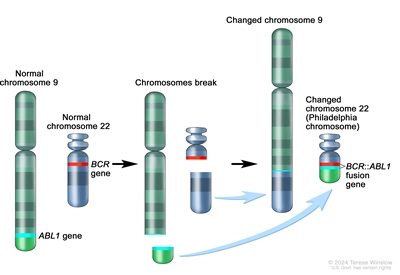
The Philadelphia (Ph) chromosome is an abnormal chromosome that is made when pieces of chromosomes 9 and 22 break off and trade places. The ABL1 gene from chromosome 9 joins to the BCR gene on chromosome 22 to form the BCR::ABL1 fusion gene. The changed chromosome 22 with the fusion gene on it is called the Ph chromosome.
Tests that examine the blood and bone marrow are used to diagnose chronic myeloid leukemia.
In addition to asking about your personal and family health history and doing a physical exam to check for signs of disease, such as an enlarged spleen, your doctor may perform the following tests and procedures:
- Complete blood count (CBC) with differential checks a sample of blood for:
- the number of red blood cells and platelets
- the number and type of white blood cells
- the amount of hemoglobin (the protein that carries oxygen) in the red blood cells
- the amount of hematocrit (whole blood that is made up of red blood cells)
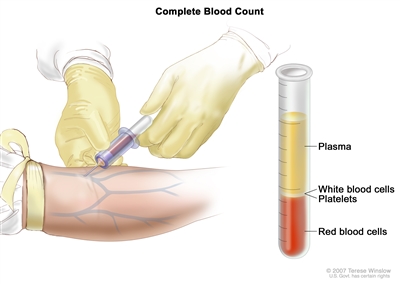
Complete blood count (CBC). Blood is collected by inserting a needle into a vein and allowing the blood to flow into a tube. The blood sample is sent to the laboratory and the red blood cells, white blood cells, and platelets are counted. The CBC is used to test for, diagnose, and monitor many different conditions. - Blood chemistry study uses a blood sample to measure the amounts of certain substances released into the blood by organs and tissues in the body. An unusual amount of a substance can be a sign of disease.
- Bone marrow aspiration and biopsy is the removal of bone marrow, blood, and a small piece of bone by inserting a needle into the hipbone or breastbone. A pathologist views the bone marrow, blood, and bone under a microscope to look for abnormal cells.
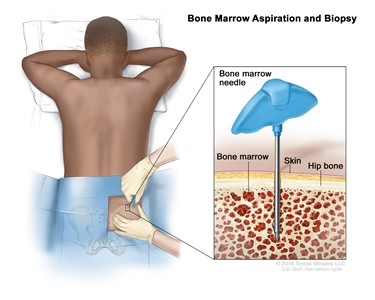
Bone marrow aspiration and biopsy. After a small area of skin is numbed, a long, hollow needle is inserted through the patient's skin and hip bone into the bone marrow. A sample of bone marrow and a small piece of bone are removed for examination under a microscope.One of the following tests may be done on the samples of blood or bone marrow tissue that are removed.
- Cytogenetic analysis checks the chromosomes of cells in a sample of bone marrow, blood, tumor, or other tissue for broken, missing, rearranged, or extra chromosomes. Changes in certain chromosomes, such as the Philadelphia chromosome, may be a sign of cancer. Cytogenetic analysis is used to help diagnose cancer, plan treatment, or find out how well treatment is working.
- FISH (fluorescence in situ hybridization) is a laboratory test used to look at and count genes or chromosomes in cells and tissues. Pieces of DNA that contain fluorescent dyes are made in the laboratory and added to a sample of a patient's cells or tissues. When these dyed pieces of DNA attach to certain genes or areas of chromosomes in the sample, they light up when viewed under a fluorescent microscope. The FISH test is used to help diagnose cancer and help plan treatment.
- Reverse transcription–polymerase chain reaction test (RT-PCR) is a laboratory test in which the amount of a genetic substance called mRNA made by a specific gene is measured. An enzyme called reverse transcriptase is used to convert a specific piece of RNA into a matching piece of DNA, which can be amplified (made in large numbers) by another enzyme called DNA polymerase. The amplified DNA copies help tell whether a specific mRNA is being made by a gene. RT-PCR can be used to check the activation of certain genes that may indicate the presence of cancer cells. This test may be used to look for certain changes in a gene or chromosome, which may help diagnose cancer.
Certain factors affect prognosis (chance of recovery) and treatment options.
The prognosis and treatment options depend on:
- the patient's age
- the phase of CML
- the amount of blasts in the blood or bone marrow
- the patient's general health
Treatment Option Overview
There are different types of treatment for patients with chronic myeloid leukemia.
Different types of treatments are available for chronic myeloid leukemia (CML). You and your cancer care team will work together to decide your treatment plan, which may include more than one type of treatment. Many factors will be considered, such as the stage of the cancer, your overall health, and your preferences. Your plan will include information about your cancer, the goals of treatment, your treatment options and the possible side effects, and the expected length of treatment.
Talking with your cancer care team before treatment begins about what to expect will be helpful. You'll want to learn what you need to do before treatment begins, how you'll feel while going through it, and what kind of help you will need. To learn more, visit
The following types of treatment are used:
Targeted therapy
Targeted therapy is a type of treatment that uses drugs or other substances to identify and attack specific cancer cells.
- Tyrosine kinase inhibitor therapy blocks the enzyme tyrosine kinase that causes stem cells to develop into more white blood cells (blasts) than the body needs.
Tyrosine kinase inhibitors used to treat CML include:
- asciminib
- imatinib mesylate
- dasatinib
- nilotinib
- bosutinib
Having bariatric surgery may block some absorption of oral tyrosine kinase inhibitors, limiting their effectiveness.
Learn more about
Chemotherapy
Chemotherapy is a cancer treatment that uses drugs to stop the growth of cancer cells, either by killing the cells or by stopping them from dividing. When chemotherapy is taken by mouth or injected into a vein or muscle, the drugs enter the bloodstream and can reach cancer cells throughout the body (systemic chemotherapy).
Learn more about
Immunotherapy
Immunotherapy is a treatment that uses the patient's immune system to fight cancer. Substances made by the body or made in a laboratory are used to boost, direct, or restore the body's natural defenses against cancer. Interferon is a type of immunotherapy used to treat CML. It affects the division of cancer cells and can slow tumor growth.
Learn more about
High-dose chemotherapy with stem cell transplant (SCT)
High doses of chemotherapy are given to kill cancer cells. Healthy cells, including blood -forming cells, are also destroyed by the cancer treatment. stem cell transplant is a treatment to replace the blood-forming cells. Stem cells (immature blood cells) are removed from the blood or bone marrow of the patient or a donor and are frozen and stored. After the patient completes chemotherapy, the stored stem cells are thawed and given back to the patient through an infusion. These reinfused stem cells grow into (and restore) the body's blood cells.
Learn more about
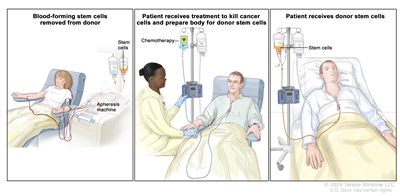
Donor stem cell transplant. (Step 1): Four to five days before donor stem cell collection, the donor receives a medicine to increase the number of stem cells circulating through their bloodstream (not shown). The blood-forming stem cells are then collected from the donor through a large vein in their arm. The blood flows through an apheresis machine that removes the stem cells. The rest of the blood is returned to the donor through a vein in their other arm. (Step 2): The patient receives chemotherapy to kill cancer cells and prepare their body for the donor stem cells. The patient may also receive radiation therapy (not shown). (Step 3): The patient receives an infusion of the donor stem cells.
Donor lymphocyte infusion (DLI)
Donor lymphocyte infusion (DLI) is a cancer treatment that may be used after stem cell transplant. Lymphocytes (a type of white blood cell) from the stem cell transplant donor are removed from the donor's blood and may be frozen for storage. The donor's lymphocytes are thawed if they were frozen and then given to the patient through one or more infusions. The lymphocytes see the patient's cancer cells as not belonging to the body and attack them.
Surgery
Splenectomy is surgery to remove the spleen.
New types of treatment are being tested in clinical trials.
For some people, joining a clinical trial may be an option. There are different types of clinical trials for people with cancer. For example, a treatment trial tests new treatments or new ways of using current treatments. Supportive care and palliative care trials look at ways to improve quality of life, especially for those who have side effects from cancer and its treatment.
You can use the
Learn more about clinical trials, including how to find and join one, at
Treatment for chronic myeloid leukemia may cause side effects.
For information about side effects caused by treatment for cancer, visit our
Follow-up care may be needed.
As you go through treatment, you will have follow-up tests or check-ups. Some tests that were done to diagnose or stage the cancer may be repeated to see how well the treatment is working. Decisions about whether to continue, change, or stop treatment may be based on the results of these tests.
Some of the tests will continue to be done from time to time after treatment has ended. The results of these tests can show if your condition has changed or if the cancer has recurred (come back).
This information does not replace the advice of a doctor. Ignite Healthwise, LLC, disclaims any warranty or liability for your use of this information. Your use of this information means that you agree to the
Healthwise, Healthwise for every health decision, and the Healthwise logo are trademarks of Ignite Healthwise, LLC.
Page Footer
I want to...
Audiences
Secure Member Sites
The Cigna Group Information
Disclaimer
Individual and family medical and dental insurance plans are insured by Cigna Health and Life Insurance Company (CHLIC), Cigna HealthCare of Arizona, Inc., Cigna HealthCare of Illinois, Inc., Cigna HealthCare of Georgia, Inc., Cigna HealthCare of North Carolina, Inc., Cigna HealthCare of South Carolina, Inc., and Cigna HealthCare of Texas, Inc. Group health insurance and health benefit plans are insured or administered by CHLIC, Connecticut General Life Insurance Company (CGLIC), or their affiliates (see
All insurance policies and group benefit plans contain exclusions and limitations. For availability, costs and complete details of coverage, contact a licensed agent or Cigna sales representative. This website is not intended for residents of New Mexico.