Skip to main navigation Skip to main content Skip to footer For Medicare For Providers For Brokers For Employers Español For Individuals & Families: For Individuals & Families Medical Dental Other Supplemental Explore coverage through work How to Buy Health Insurance Types of Dental Insurance Open Enrollment vs. Special Enrollment See all topics Shop for Medicare plans Member Guide Find a Doctor Log in to myCigna
Home Knowledge Center Wellness Library Coronary Artery Bypass Graft Surgery

Coronary Artery Bypass Graft Surgery

Coronary artery bypass graft (CABG) surgery is used to treat coronary artery disease. It helps blood flow around, or bypass, one or more narrowed or blocked coronary arteries. The arteries may have plaque buildup (atherosclerosis). These arteries are the blood vessels that bring blood to the heart muscle. This surgery is also called bypass surgery.

Your doctor will make the bypass with a healthy piece of blood vessel from another part of your body. Then the doctor will attach, or graft, the healthy blood vessel above and below the narrowed or blocked artery. Blood is redirected through the new blood vessel. This restores blood flow to the affected portion of the heart muscle.

The doctor usually makes a cut in the skin over your breastbone (sternum). This cut is called an incision. Then the doctor will cut through your sternum to reach your heart and coronary arteries. A heart-lung bypass machine is usually used during the surgery to add oxygen to the blood and move the blood through the body. The doctor will use blood vessels from your chest, arm, or leg to bypass the narrowed or blocked parts of your arteries. In some cases, the doctor may be able to do the surgery without using a heart-lung machine. This is called "off-pump" surgery.

The doctor may use wire to put your sternum back together. Stitches or staples will be used to close the incisions in the skin over your sternum and the arm or leg where your healthy blood vessel was taken. The wire will stay in your chest. The incisions will leave scars that may fade with time.

You will stay in the hospital for a few days after surgery. You will probably be able to do many of your usual activities after 4 to 6 weeks. But for at least 6 weeks you will avoid lifting heavy objects and doing things that strain your chest or upper arm muscles. At first you may notice that you get tired quickly. You may need to rest often. It may take 1 to 2 months before your energy is back to normal.

How It Is Done

How It Is Done

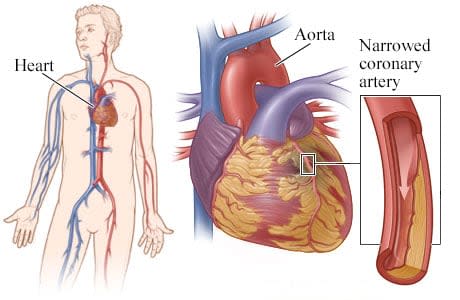
Heart, with detail of coronary artery narrowed by plaque.

Coronary artery bypass graft surgery redirects blood around narrowed or blocked arteries, increasing blood flow to the heart muscle.
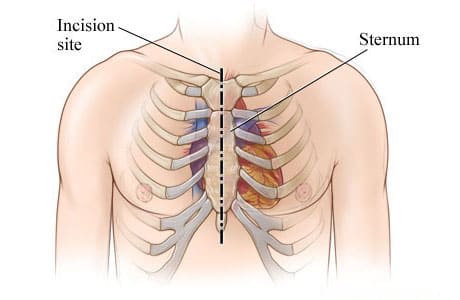
Location of incision in chest.

Bypass surgery is most often done as an open-heart surgery. The surgeon makes a vertical incision in the skin and muscle in the middle of the chest and then cuts through the breastbone (sternum).
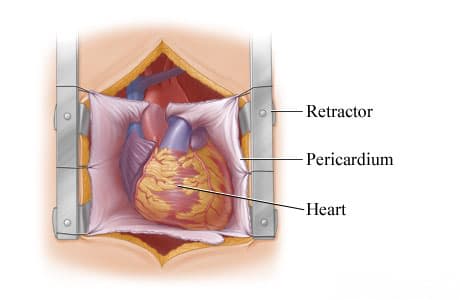
Retractor exposing the heart in the chest

The surgeon spreads the rib cage with a retractor to expose the heart and then cuts through the lining that protects the heart (pericardium).
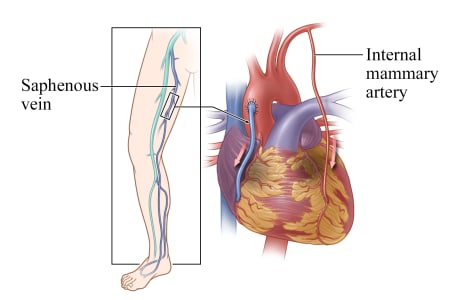
Location of saphenous vein in leg, and heart showing saphenous vein and an internal mammary artery used to bypass the diseased coronary artery.

To redirect blood flow around the narrowed or blocked arteries, the surgeon uses a healthy piece of blood vessel taken from another part of your body. For example, the saphenous vein from the leg or an internal mammary artery from the chest may be used.
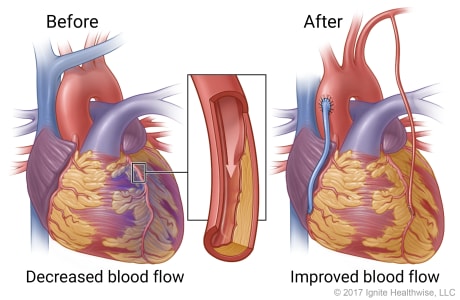
Decreased blood flow caused by narrowed or blocked artery before surgery and improved blood flow after surgery.

Blood is redirected through the new blood vessel. This restores blood flow to the affected portion of the heart muscle.

What To Expect

What To Expect

Right after surgery

You will go to the intensive care unit (ICU) after surgery. You will probably stay in the ICU for 1 or 2 days before you go to your regular hospital room. In the ICU, you will likely have:

  • Continuous monitoring of your heart.
  • A tube to help with breathing for up to a few hours.
  • A thin stomach tube that removes stomach juices until you start to eat again.
  • A tube to drain urine from the bladder and measure urine output.
  • An intravenous (I.V.) tube, called a catheter, in your arms to get fluids, nutrition, and medicine.
  • A catheter in a vein in your neck that keeps track of how well your heart is working.
  • A catheter in an artery in your arm to measure blood pressure.
  • Several thin wires coming out of your chest. These help keep your heartbeat steady.
  • Chest tubes. These tubes drain the chest cavity of fluid and blood (which is temporary and normal) after surgery.

Many of these monitoring devices are usually removed within a few days of surgery.

Recovery

You will stay in the hospital for at least a few days after the surgery. You will feel tired and sore for the first few weeks. Your chest, shoulders, and upper back may ache. These symptoms usually get better in 4 to 6 weeks. It may take 1 to 2 months before your energy level is back to normal. You may have some swelling or pain in the area where the healthy blood vessel used for the bypass was taken.

You will probably be able to do many of your usual activities after 4 to 6 weeks. But for at least 6 weeks, you'll avoid lifting heavy objects and doing activities that strain your chest or upper arm muscles.

After surgery, follow a heart-healthy lifestyle. This lifestyle can help lower your risk of a heart attack or stroke or other heart problems. It also can help the bypass graft last as long as possible. To have a heart-healthy lifestyle:

  • Take your medicines as instructed.
  • Eat a heart-healthy diet.
  • Get regular exercise.
  • Stay at a weight that's healthy for you. Talk to your doctor if you need help with this.
  • Manage other health problems such as diabetes, high blood pressure, and high cholesterol.
  • Do not smoke or vape. Also avoid secondhand smoke and the aerosol mist from vaping.

Smoking or vaping can make it harder for you to recover. It will raise the risk of your arteries getting narrowed or blocked again. If you need help quitting, talk to your doctor about quit programs and medicines. These can increase your chances of quitting for good. Secondhand smoke and vaping mist can also increase your risk for problems.

You may start a cardiac rehabilitation (rehab) program in the hospital. This program will continue after you go home. It will help you recover. And it can prevent future problems with your heart.

Learn more

Why It Is Done

Why It Is Done

Bypass surgery is done to treat a heart attack and coronary artery disease. Surgery might be an option for many reasons. These reasons include the following:

  • Your left main heart artery is very narrow. This artery supplies blood to a large part of the heart muscle.
  • Multiple arteries of the heart are blocked or the amount of blood flowing through them is very low.
  • You are going to have surgery to repair or replace a heart valve.
  • You have diabetes and two or more narrowed or blocked arteries.
  • Your heart is having trouble pumping. This is called a decreased ejection fraction.
  • Angina has not gotten better with medicine.

Whether surgery is an option for you also depends on your age, your health, and how much your symptoms are affecting your quality of life. Your doctor is likely to recommend bypass surgery only if you will benefit from it and if those benefits are greater than the risks. You and your doctor can work together to decide if you want to have surgery.

How Well It Works

How Well It Works

Bypass surgery:

  • Can relieve angina symptoms and improve your quality of life. You may be able to do more of your daily activities.
  • May help people who have angina and other health problems feel better and improve their quality of life. For example, the surgery can improve blood flow to the heart if you have diabetes and narrowing in your heart's larger arteries.
  • Improves blood flow to the heart muscle after a heart attack.
Risks

Risks

The risks during or soon after bypass surgery include:

  • Infection.
  • Kidney problems.
  • Atrial fibrillation.
  • Heart attack.
  • Stroke.
  • Short-term problems with thinking and memory. This is more common in older people. It tends to get better within several months of surgery.
  • Death.

The chances of having a serious problem with bypass surgery increase with age. Your risk is also higher if you have other problems such as diabetes, kidney disease, lung disease, or peripheral arterial disease. Your doctor can help you understand what your risk for problems is.

This information does not replace the advice of a doctor. Ignite Healthwise, LLC, disclaims any warranty or liability for your use of this information. Your use of this information means that you agree to the Terms of Use. Learn how we develop our content.

© 2024-2025 Ignite Healthwise, LLC.

<cipublic-spinner variant="large"><span>Loading…</span></cipublic-spinner>

Page Footer

I want to...

Get an ID card File a claim View my claims and EOBs Check coverage under my plan See prescription drug list Find an in-network doctor, dentist, or facility Find a form Find 1095-B tax form information View the Cigna Glossary Contact Cigna

Audiences

Individuals and Families Medicare Employers Brokers Providers

Secure Member Sites

myCigna member portal Health Care Provider portal Cigna for Employers Client Resource Portal Cigna for Brokers

The Cigna Group Information

About Cigna Healthcare Company Profile Careers Newsroom Investors Suppliers The Cigna Group Third Party Administrators International Evernorth

 Cigna. All rights reserved.

Privacy Legal Product Disclosures Cigna Company Names Customer Rights Accessibility Non-Discrimination Notice Language Assistance [PDF] Report Fraud Sitemap Cookie Settings

Disclaimer

Individual and family medical and dental insurance plans are insured by Cigna Health and Life Insurance Company (CHLIC), Cigna HealthCare of Arizona, Inc., Cigna HealthCare of Illinois, Inc., Cigna HealthCare of Georgia, Inc., Cigna HealthCare of North Carolina, Inc., Cigna HealthCare of South Carolina, Inc., and Cigna HealthCare of Texas, Inc. Group health insurance and health benefit plans are insured or administered by CHLIC, Connecticut General Life Insurance Company (CGLIC), or their affiliates (see a listing of the legal entities that insure or administer group HMO, dental HMO, and other products or services in your state). Accidental Injury, Critical Illness, and Hospital Care plans or insurance policies are distributed exclusively by or through operating subsidiaries of Cigna Corporation, are administered by Cigna Health and Life Insurance Company, and are insured by either (i) Cigna Health and Life Insurance Company (Bloomfield, CT); (ii) Life Insurance Company of North America (“LINA”) (Philadelphia, PA); or (iii) New York Life Group Insurance Company of NY (“NYLGICNY”) (New York, NY), formerly known as Cigna Life Insurance Company of New York. The Cigna name, logo, and other Cigna marks are owned by Cigna Intellectual Property, Inc. LINA and NYLGICNY are not affiliates of Cigna.

All insurance policies and group benefit plans contain exclusions and limitations. For availability, costs and complete details of coverage, contact a licensed agent or Cigna sales representative. This website is not intended for residents of New Mexico.

Selecting these links will take you away from Cigna.com to another website, which may be a non-Cigna website. Cigna may not control the content or links of non-Cigna websites. Details