Merkel Cell Carcinoma Treatment (PDQ®): Treatment - Patient Information [NCI]
General Information About Merkel Cell Carcinoma
Merkel cell carcinoma is a very rare type of cancer that forms in the skin.
Merkel cells are found in the top layer of the skin. These cells are very close to the nerve endings that receive the sensation of touch. Merkel cell carcinoma, also called neuroendocrine carcinoma of the skin or trabecular cancer, is a very rare type of skin cancer that forms when Merkel cells grow out of control. Merkel cell carcinoma starts most often in areas of skin exposed to the sun, especially the head and neck, as well as the arms, legs, and trunk.
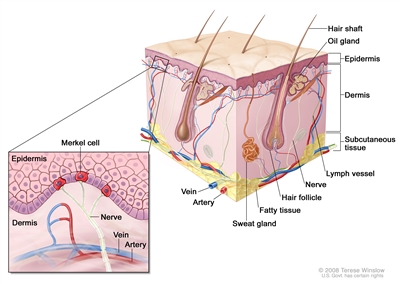
Anatomy of the skin showing the epidermis, dermis, and subcutaneous tissue. Merkel cells are in the layer of basal cells at the deepest part of the epidermis and are connected to nerves.
Merkel cell carcinoma tends to grow quickly and to metastasize (spread) at an early stage. It usually spreads first to nearby lymph nodes and then may spread to lymph nodes or skin in distant parts of the body, lungs, brain, bones, or other organs.
Merkel cell carcinoma is the second most common cause of skin cancer death after melanoma.
Sun exposure and having a weak immune system affects the risk of developing Merkel cell carcinoma.
Anything that increases a person's chance of getting a disease is called a risk factor. Not every person with one or more of these risk factors will develop Merkel cell carcinoma, and it can develop in people who don't have any known risk factors. Talk with your doctor if you think you may be at risk.
Risk factors for Merkel cell carcinoma include:
- being exposed to a lot of natural sunlight
- being exposed to artificial sunlight, such as from tanning beds or psoralen and ultraviolet A (PUVA) therapy for psoriasis
- having an immune system weakened by disease, such as chronic lymphocytic leukemia or HIV infection
- taking medicine that makes the immune system less active, such as after an organ transplant
- having a history of other types of cancer
- being older than 50 years, male, or White
Merkel cell carcinoma usually appears as a single painless lump on sun-exposed skin.
This and other changes in the skin may be caused by Merkel cell carcinoma or by other conditions. Check with your doctor if you see changes in your skin.
Merkel cell carcinoma usually appears on sun-exposed skin as a single lump that is:
- fast-growing
- painless
- firm and dome-shaped or raised
- red or violet in color
Tests that examine the skin are used to diagnose Merkel cell carcinoma.
In addition to asking about your personal and family health history and doing a physical exam, your doctor may perform the following tests and procedures:
- Full-body skin exam is an exam of the skin. A doctor or nurse checks the skin for bumps or spots that look abnormal in color, size, shape, or texture. The size, shape, and texture of the lymph nodes will also be checked.
- Skin biopsy is the removal of skin cells or tissues so they can be viewed under a microscope by a pathologist to check for signs of cancer.
After Merkel cell carcinoma has been diagnosed, tests are done to find out if cancer cells have spread to other parts of the body.
The process used to find out if cancer has spread to other parts of the body is called staging. The information gathered from the staging process determines the stage of the disease. It is important to know the stage in order to plan treatment.
The following tests and procedures may be used in the staging process:
- CT scan (CAT scan) uses a computer linked to an x-ray machine to make a series of detailed pictures of areas inside the body, such as the chest, abdomen, head, and neck. The pictures are taken from different angles and are used to create 3-D views of tissues and organs. A dye may be injected into a vein or swallowed to help the organs or tissues show up more clearly. This procedure is also called computed tomography, computerized tomography, or computerized axial tomography. Learn more about
Computed Tomography (CT) Scans and Cancer . - PET scan (positron emission tomography scan) uses a small amount of radioactive sugar (also called radioactive glucose) that is injected into a vein. The PET scanner rotates around the body and makes pictures of where sugar is being used by the body. Cancer cells show up brighter in the pictures because they are more active and take up more sugar than normal cells do.
- Lymph node biopsy is the removal of all or part of a lymph node. A pathologist views the lymph node tissue under a microscope to check for cancer cells. This procedure is also called lymph node sampling. There are several types of lymph node biopsy used to stage Merkel cell carcinoma.
- Sentinel lymph node biopsy removes the sentinel lymph node during surgery. The sentinel lymph node is the first lymph node in a group of lymph nodes to receive lymphatic drainage from the primary tumor. It is therefore the first lymph node the cancer is likely to spread to from the primary tumor. To identify the sentinel lymph node, a radioactive substance, blue dye, or both is injected near the tumor. The substance or dye flows through the lymph ducts to the lymph nodes. The first lymph node to receive the substance or dye is removed. A pathologist views the tissue under a microscope to look for cancer cells. If cancer cells are found, more lymph nodes will be removed through a separate incision (cut). This is called a lymph node dissection. Sometimes, a sentinel lymph node is found in more than one group of nodes.
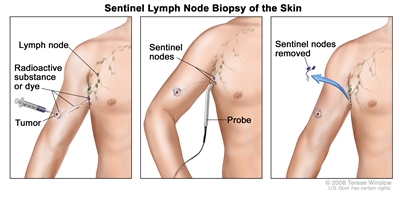
Sentinel lymph node biopsy of the skin. A radioactive substance and/or blue dye is injected near the tumor (first panel). The injected material is detected visually and/or with a probe that detects radioactivity (middle panel). The sentinel nodes (the first lymph nodes to take up the material) are removed and checked for cancer cells (last panel). - Lymph node dissection is a surgical procedure in which the lymph nodes are removed and a sample of tissue is checked under a microscope for signs of cancer. For a regional lymph node dissection, some of the lymph nodes in the tumor area are removed. For a radical lymph node dissection, most or all of the lymph nodes in the tumor area are removed. This procedure is also called lymphadenectomy.
- Core needle biopsy is a procedure to remove a sample of tissue using a wide needle. A pathologist views the tissue under a microscope to look for cancer cells.
- Fine-needle aspiration biopsy is a procedure to remove a sample of tissue using a thin needle. A pathologist views the tissue under a microscope to look for cancer cells.
- Sentinel lymph node biopsy removes the sentinel lymph node during surgery. The sentinel lymph node is the first lymph node in a group of lymph nodes to receive lymphatic drainage from the primary tumor. It is therefore the first lymph node the cancer is likely to spread to from the primary tumor. To identify the sentinel lymph node, a radioactive substance, blue dye, or both is injected near the tumor. The substance or dye flows through the lymph ducts to the lymph nodes. The first lymph node to receive the substance or dye is removed. A pathologist views the tissue under a microscope to look for cancer cells. If cancer cells are found, more lymph nodes will be removed through a separate incision (cut). This is called a lymph node dissection. Sometimes, a sentinel lymph node is found in more than one group of nodes.
- Immunohistochemistry uses antibodies to check for certain antigens (markers) in a sample of a patient's cells or tissue. The antibodies are usually linked to an enzyme or a fluorescent dye. After the antibodies bind to a specific antigen in the tissue sample, the enzyme or dye is activated, and the antigen can then be seen under a microscope. This type of test is used to help diagnose cancer and help tell one type of cancer from another type.
Some people decide to get a second opinion.
You may want to get a second opinion to confirm your Merkel cell carcinoma diagnosis and treatment plan. If you seek a second opinion, you will need to get medical test results and reports from the first doctor to share with the second doctor. The second doctor will review the pathology report, slides, and scans. They may agree with the first doctor, suggest changes or another treatment approach, or provide more information about your cancer.
Learn more about choosing a doctor and getting a second opinion at
Certain factors affect prognosis (chance of recovery) and treatment options.
The prognosis and treatment options depend on:
- the stage of the cancer (the size of the tumor and whether it has spread to the lymph nodes or other parts of the body)
- where the cancer is in the body
- whether the cancer has just been diagnosed or has recurred (come back)
- the person's age and general health
Prognosis also depends on how deeply the tumor has grown into the skin.
Stages of Merkel Cell Carcinoma
Cancer stage describes the extent of cancer in the body, such as the size of the tumor, whether it has spread, and how far it has spread from where it first formed. It is important to know the stage of Merkel cell cancer to plan the best treatment.
There are several staging systems for cancer that describe the extent of the cancer. Merkel cell carcinoma staging usually uses the TNM staging system. The cancer may be described by this staging system in your pathology report. Based on the TNM results, a stage (I, II, III, or IV, also written as 1, 2, 3, or 4) is assigned to your cancer. When talking to you about your diagnosis, your doctor may describe the cancer as one of these stages.
Learn about
The following stages are used for Merkel cell carcinoma:
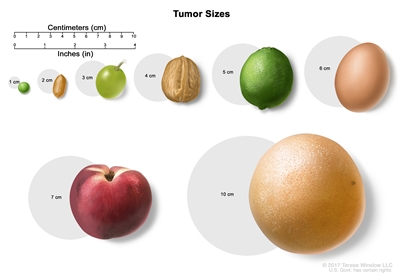
Tumor sizes are often measured in centimeters (cm) or inches. Common food items that can be used to show tumor size in cm include: a pea (1 cm), a peanut (2 cm), a grape (3 cm), a walnut (4 cm), a lime (5 cm or 2 inches), an egg (6 cm), a peach (7 cm), and a grapefruit (10 cm or 4 inches).
Stage 0 (carcinoma in situ)
In stage 0, abnormal Merkel cells are found in the top layer of skin. These abnormal cells may become cancer and spread into nearby normal tissue.
Stage I (also called Stage 1) Merkel cell carcinoma
In stage I, the tumor is 2 centimeters or smaller.
Stage II (also called Stage 2) Merkel cell carcinoma
Stage II Merkel cell carcinoma is divided into stages IIA and IIB.
- In stage IIA, the tumor is larger than 2 centimeters.
- In stage IIB, the tumor has spread to nearby connective tissue, muscle, cartilage, or bone.
Stage III (also called Stage 3) Merkel cell carcinoma
Stage III Merkel cell carcinoma is divided into stages IIIA and IIIB.
In stage IIIA, either of the following is found:
- the tumor may be any size and may have spread to nearby connective tissue, muscle, cartilage, or bone. A lymph node cannot be felt during a physical exam but cancer is found in the lymph node by sentinel lymph node biopsy or after the lymph node is removed and checked under a microscope for signs of cancer; or
- a swollen lymph node is felt during a physical exam and/or seen on an imaging test. When the lymph node is removed and checked under a microscope for signs of cancer, cancer is found in the lymph node. The place where the cancer began is not known.
In stage IIIB, the tumor may be any size and:
- may have spread to nearby connective tissue, muscle, cartilage, or bone. A swollen lymph node is felt during a physical exam and/or seen on an imaging test. When the lymph node is removed and checked under a microscope for signs of cancer, cancer is found in the lymph node; or
- cancer is in a lymph vessel between the primary tumor and lymph nodes that are near or far away. Cancer may have spread to lymph nodes.
Stage IV (also called Stage 4) Merkel cell carcinoma
In stage IV, the tumor has spread to skin that is not close to the primary tumor or to other parts of the body, such as the liver, lung, bone, or brain.
Stage IV Merkel cell carcinoma is also called metastatic Merkel cell carcinoma. Metastatic cancer happens when cancer cells travel through the lymphatic system or blood and form tumors in other parts of the body. The metastatic tumor is the same type of cancer as the primary tumor. For example, if Merkel cell carcinoma spreads to the liver, the cancer cells in the liver are actually Merkel cell carcinoma cells. The disease is called metastatic Merkel cell carcinoma, not liver cancer. Learn more in
It is common for Merkel cell carcinoma to recur (come back) after it has been treated.
Recurrent Merkel cell carcinoma is cancer that has come back after it has been treated. If Merkel cell carcinoma comes back, it may come back in the skin, lymph nodes, or other parts of the body. Tests will be done to help determine where the cancer has returned. The type of treatment for recurrent Merkel cell carcinoma will depend on where it has come back.
Learn more in
This information does not replace the advice of a doctor. Ignite Healthwise, LLC, disclaims any warranty or liability for your use of this information. Your use of this information means that you agree to the
Healthwise, Healthwise for every health decision, and the Healthwise logo are trademarks of Ignite Healthwise, LLC.
Page Footer
I want to...
Audiences
Secure Member Sites
The Cigna Group Information
Disclaimer
Individual and family medical and dental insurance plans are insured by Cigna Health and Life Insurance Company (CHLIC), Cigna HealthCare of Arizona, Inc., Cigna HealthCare of Illinois, Inc., Cigna HealthCare of Georgia, Inc., Cigna HealthCare of North Carolina, Inc., Cigna HealthCare of South Carolina, Inc., and Cigna HealthCare of Texas, Inc. Group health insurance and health benefit plans are insured or administered by CHLIC, Connecticut General Life Insurance Company (CGLIC), or their affiliates (see
All insurance policies and group benefit plans contain exclusions and limitations. For availability, costs and complete details of coverage, contact a licensed agent or Cigna sales representative. This website is not intended for residents of New Mexico.