Pheochromocytoma and Paraganglioma Treatment (PDQ®): Treatment - Patient Information [NCI]
General Information About Pheochromocytoma and Paraganglioma
Pheochromocytoma and paraganglioma are rare tumors that come from the same type of tissue.
Paragangliomas form in nerve tissue in the adrenal glands and near certain blood vessels and nerves. Paragangliomas that form in the adrenal glands are called pheochromocytomas. Paragangliomas that form outside the adrenal glands are called extra-adrenal paragangliomas. In this summary, extra-adrenal paragangliomas are called paragangliomas.
Pheochromocytomas and paragangliomas may be benign (not cancer) or cancer.
Pheochromocytoma is a rare tumor that forms in the adrenal medulla (the center of the adrenal gland).
Pheochromocytoma forms in the adrenal glands. There are two adrenal glands, one on top of each kidney in the back of the upper abdomen. Each adrenal gland has two parts. The outer layer of the adrenal gland is the adrenal cortex. The center of the adrenal gland is the adrenal medulla.
Pheochromocytoma is a rare tumor of the adrenal medulla. Usually, pheochromocytoma affects one adrenal gland, but it may affect both adrenal glands. Sometimes there is more than one tumor in one adrenal gland.
The adrenal glands make important hormones called catecholamines. Adrenaline (epinephrine) and noradrenaline (norepinephrine) are two types of catecholamines that help control heart rate, blood pressure, blood sugar, and the way the body reacts to stress. Sometimes a pheochromocytoma will release extra adrenaline and noradrenaline into the blood and cause signs or symptoms of disease. 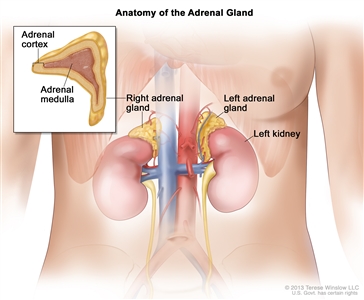
Anatomy of the adrenal gland. There are two adrenal glands, one on top of each kidney. The outer part of each gland is the adrenal cortex and the inner part is the adrenal medulla.
Paragangliomas form outside the adrenal gland.
Paragangliomas are rare tumors that form near the carotid artery, along nerve pathways in the head and neck, and in other parts of the body. Some paragangliomas make extra catecholamines called adrenaline and noradrenaline. The release of these extra catecholamines into the blood may cause signs or symptoms of disease.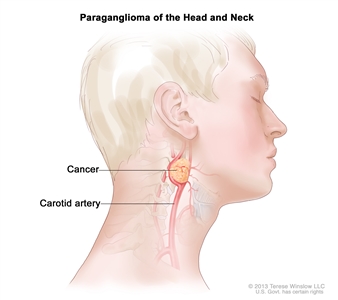
Paraganglioma of the head and neck. A rare tumor that often forms near the carotid artery. It may also form along nerve pathways in the head and neck and in other parts of the body.
Some inherited disorders and changes in certain genes increase the risk of pheochromocytoma or paraganglioma.
Anything that increases your chance of getting a disease is called a risk factor. Having a risk factor doesn't mean that you will get cancer; not having risk factors doesn't mean that you will not get cancer. Talk to your doctor if you think you may be at risk.
The following inherited syndromes or gene changes increase the risk of pheochromocytoma or paraganglioma:
- Multiple endocrine neoplasia 2 syndrome, types A and B (MEN2A and MEN2B).
- von Hippel-Lindau (VHL) syndrome.
- Neurofibromatosis type 1 (NF1).
- Hereditary paraganglioma-pheochromocytoma syndrome.
- Hereditary leiomyomatosis and renal cell cancer.
- Carney-Stratakis dyad (paraganglioma and gastrointestinal stromal tumor [GIST]).
- Carney triad (paraganglioma, GIST, and pulmonary chondroma).
Signs and symptoms of pheochromocytoma and paraganglioma include high blood pressure and headache.
Some tumors do not make extra adrenaline or noradrenaline and do not cause signs and symptoms. These tumors are sometimes found when a lump forms in the neck or when a test or procedure is done for another reason. Signs and symptoms of pheochromocytoma and paraganglioma occur when too much adrenaline or noradrenaline is released into the blood. These and other signs and symptoms may be caused by pheochromocytoma and paraganglioma or by other conditions. Check with your doctor if you have:
- High blood pressure.
- Headache.
- Heavy sweating for no known reason.
- A strong, fast, or irregular heartbeat.
- Being shaky.
- Being extremely pale.
The most common sign is high blood pressure that may be hard to control. Very high blood pressure can cause serious health problems such as irregular heartbeat, heart attack, stroke, or death.
Signs and symptoms of pheochromocytoma and paraganglioma may occur at any time or be brought on by certain events.
Signs and symptoms of pheochromocytoma and paraganglioma may occur when one of the following events happens:
- Hard physical activity.
- A physical injury or having a lot of emotional stress.
- Childbirth.
- Going under anesthesia.
- Surgery, including procedures to remove the tumor.
- Eating foods high in tyramine (such as red wine, chocolate, and cheese).
Tests that examine the blood and urine are used to diagnose pheochromocytoma and paraganglioma.
In addition to asking about your personal and family health history and doing a physical exam to check for signs of disease, such as high blood pressure, your doctor may perform the following tests and procedures:
- Twenty-four-hour urine test: A test in which urine is collected for 24 hours to measure the amounts of catecholamines in the urine. Substances caused by the breakdown of these catecholamines are also measured. An unusual (higher or lower than normal) amount of a substance can be a sign of disease in the organ or tissue that makes it. Higher-than-normal amounts of certain catecholamines may be a sign of pheochromocytoma.
- Blood catecholamine studies: A procedure in which a blood sample is checked to measure the amount of certain catecholamines released into the blood. Substances caused by the breakdown of these catecholamines are also measured. An unusual (higher than or lower than normal) amount of a substance can be a sign of disease in the organ or tissue that makes it. Higher-than-normal amounts of certain catecholamines may be a sign of pheochromocytoma.
- CT scan (CAT scan): A procedure that makes a series of detailed pictures of areas inside the body, such as the neck, chest, abdomen, and pelvis, taken from different angles. The pictures are made by a computer linked to an x-ray machine. A dye may be injected into a vein or swallowed to help the organs or tissues show up more clearly. This procedure is also called computed tomography, computerized tomography, or computerized axial tomography.
- MRI (magnetic resonance imaging): A procedure that uses a magnet, radio waves, and a computer to make a series of detailed pictures of areas inside the body such as the neck, chest, abdomen, and pelvis. This procedure is also called nuclear magnetic resonance imaging (NMRI).
Genetic counseling is part of the treatment plan for patients with pheochromocytoma or paraganglioma.
All patients who are diagnosed with pheochromocytoma or paraganglioma should have genetic counseling to find out their risk for having an inherited syndrome and other related cancers.
Genetic testing is often recommended by a genetic counselor for patients who:
- Have a personal or family history of traits linked with inherited pheochromocytoma or paraganglioma syndrome.
- Have tumors in both adrenal glands.
- Have more than one tumor in one adrenal gland.
- Have signs or symptoms of extra catecholamines being released into the blood or malignant (cancerous) paraganglioma.
- Are diagnosed before age 40 years.
Genetic testing is sometimes recommended for patients with pheochromocytoma who:
- Are aged 40 to 50 years.
- Have a tumor in one adrenal gland.
- Do not have a personal or family history of an inherited syndrome.
When certain gene changes are found during genetic testing, the testing is usually offered to family members who are at risk but do not have signs or symptoms.
Genetic testing is not recommended for patients older than 50 years.
Certain factors affect prognosis (chance of recovery) and treatment options.
The prognosis and treatment options depend on:
- Whether the tumor is benign or malignant.
- Whether the tumor is in one area only or has spread to other places in the body.
- Whether there are signs or symptoms caused by a higher-than-normal amount of catecholamines.
- Whether the tumor has just been diagnosed or has recurred (come back).
This information does not replace the advice of a doctor. Ignite Healthwise, LLC, disclaims any warranty or liability for your use of this information. Your use of this information means that you agree to the
Healthwise, Healthwise for every health decision, and the Healthwise logo are trademarks of Ignite Healthwise, LLC.
Page Footer
I want to...
Audiences
Secure Member Sites
The Cigna Group Information
Disclaimer
Individual and family medical and dental insurance plans are insured by Cigna Health and Life Insurance Company (CHLIC), Cigna HealthCare of Arizona, Inc., Cigna HealthCare of Illinois, Inc., Cigna HealthCare of Georgia, Inc., Cigna HealthCare of North Carolina, Inc., Cigna HealthCare of South Carolina, Inc., and Cigna HealthCare of Texas, Inc. Group health insurance and health benefit plans are insured or administered by CHLIC, Connecticut General Life Insurance Company (CGLIC), or their affiliates (see
All insurance policies and group benefit plans contain exclusions and limitations. For availability, costs and complete details of coverage, contact a licensed agent or Cigna sales representative. This website is not intended for residents of New Mexico.